

Replacing a galvanized water service line
Rusty water, weak pressure, or a leak in an older house can mean the pipe from the street is old galvanized steel. New Jersey treats that pipe as a lead line, so it is on the state's replacement list. Here is how to tell, and what the dig involves.
A galvanized service line is the steel pipe that runs from the water main to your house. Under NJDEP's reading of state law it counts as a lead service line, so your water system has to replace it as part of the statewide program, and the whole line from the main to the house is meant to be replaced, not one half. If it is also failing, you do not have to wait for your turn on their list. Galvanized pipe inside the house is a separate job for a plumber.
Signs the line may be galvanized and failing
Rusty or brown water
Most noticeable first thing in the morning or after the house has been empty for a few days, because the water has been sitting against the pipe wall the longest.
Pressure that faded over years
Low at every tap, not just one, and it got that way slowly. A galvanized pipe rusts from the inside, so the opening narrows even though the pipe looks fine from outside. A sudden drop is a different problem and starts with a call to your water utility.
Leaks and wet ground
A soft patch in the lawn that stays wet in dry weather, or a water bill that jumps, can point at the buried line.
None of these proves the pipe is galvanized, and none proves the problem is the buried line. Old galvanized pipe inside the walls causes the same symptoms. The check that settles the material takes five minutes and a magnet, and it is on how to tell what your water line is made of. The pressure symptom, and how to tell one fixture from the whole house, is covered in low pressure through the whole house.
Why galvanized matters under NJ lead service line rules
Galvanized steel is not lead, but New Jersey treats it as if it were. NJDEP's FAQ on the lead service line requirements says that under N.J.S.A. 58:12A-41 a galvanized service is considered a lead service line, and that galvanized materials are presumed to include lead. It also says galvanized lines will need to be replaced in accordance with the Act, and that water systems have to keep to a replacement rate that meets a 2031 deadline.
Three details from the same document are the ones that change what you do:
- The whole line, not half. NJDEP says a water system must fully replace all lead service lines regardless of who owns which part, and that partial replacement is a last resort for emergencies such as a break or a main replacement.
- Coordinate before you hire. A homeowner can replace their own portion, but NJDEP says they should work with the water system first, because a partial replacement can raise lead levels in the water afterward.
- Who pays depends on the utility. Investor-owned systems spread the cost across their customers. Government-owned systems may spread it or assess the property. Funding for the property-owner side, and the deadline calendar, are on the lead and galvanized program page so they are not repeated here.
Source: NJDEP: Frequently Asked Questions on Lead Service Line Replacement Requirements (PDF, July 2024). This is the July 2024 version of the FAQ, so check NJDEP's site for the current one. We read it in full on November 16, 2026.
What replacing it involves
1. Confirm what the line is
Rust and low pressure are clues, not proof. The five-minute check at your meter is on the lead and galvanized page. We also locate the real path of the line from the main to the house before anything is dug.
2. Call 811 and wait for the marks
Markouts are called in on every job before a machine touches the ground.
3. Coordinate with your water system
The water has to be shut off at the water system's valve. NJDEP says the contractor should contact the water system for access to shut the water off, so we make that call and work out the connection with them.
4. Dig or bore, and lay the new line
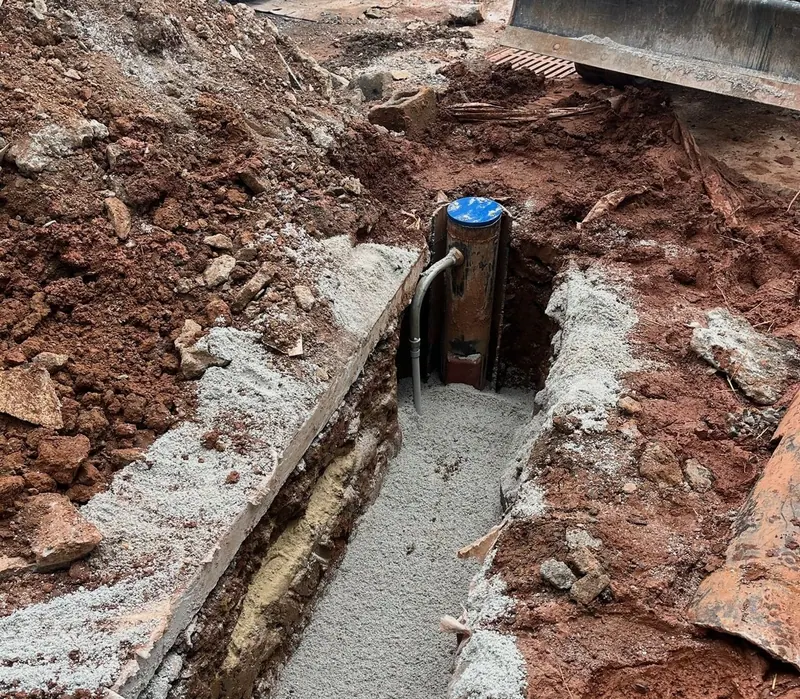
Open trench, or a bore where a driveway, walkway or mature tree is in the way. The new line goes in curb to house on proper bedding at the depth your town and water system require.
5. Replace the fittings with it
NJDEP says that when a galvanized service line is replaced, galvanized fittings or connectors on that line should be replaced along with it.
6. Backfill and restore
Compacted backfill, topsoil and seed, and hardscape repair. The job is done when the surface is back, not when the pipe is in.
NJDEP also says all lead portions of the line must be removed, in most cases extending at least three feet past where the pipe enters the building, and past the meter up to the shutoff valve where the meter sits farther in. The general job is described on water service replacement, and who shuts the water off in your town is on who supplies water in your NJ town.
What it costs
- Water service replacement: $8,000 to $10,000 for a 200 foot service.
- What moves it: the length of the run, the material the town will accept, rock and wet ground, and whether the line has to get under a driveway or a mature tree.
Our own northern New Jersey pricing as of August 2026. This is not a quote. Estimates are free when you know what you want done. Finding the problem or designing the fix is a paid visit.
Common questions
Is a galvanized water service line treated as a lead line in New Jersey?
Yes. NJDEP's FAQ says that under N.J.S.A. 58:12A-41 a galvanized service is considered to be a lead service line, and that galvanized materials are presumed to include lead. That is why galvanized lines are counted with lead lines in the state's inventories.
Does my galvanized service line have to be replaced?
NJDEP's answer is that galvanized service lines will need to be replaced in accordance with the Safe Drinking Water Act, and it points to a 2031 deadline for water systems to meet their replacement rate. When your own line comes up depends on your water system's plan, so ask them for your address. You do not have to wait for them if the line is failing.
Who pays to replace a galvanized service line?
It depends on who runs your water system. NJDEP says that for an investor-owned system the cost of replacing lead lines, minus any grants, is borne by all of that system's customers. For a government-owned system the cost may be shared by all customers or assessed to the property. Ask your water system which applies to you before you hire anyone.
Does the rule cover galvanized pipe inside my house?
No. NJDEP defines a service line as any piping, tubing or fitting connecting a water main to a building. Galvanized pipe inside the walls is not the service line, and replacing it is a plumber's repipe, not an excavation job. Plenty of older homes have both, so it is worth finding out which one is actually restricting your water before you dig.
What does it cost to replace a water service line?
$8,000 to $10,000 for a 200 foot service as of August 2026 in northern New Jersey. It is quoted against a stated length on purpose, because a price with no distance attached cannot be compared and the length of the run is most of the job.
Photos from our jobs
Three steps, no runaround
Call or send the form
Call us at 862-268-2510, or tell us about the job online. Emergencies jump the line.
Free estimates when you know what you want done
We look at the ground, tell you straight what it needs, and give you a fair, upfront price. When we have to find the problem or design the fix (camera inspection, site evaluation, design), that's a paid visit, credited toward the job if you hire us.
We do the work
Markouts and permits handled. We dig, backfill, restore, and walk the finished job with you.


Serving northern & central New Jersey
Line rusted out, or leaking?
We locate it, coordinate with your water system, and replace it curb to house.